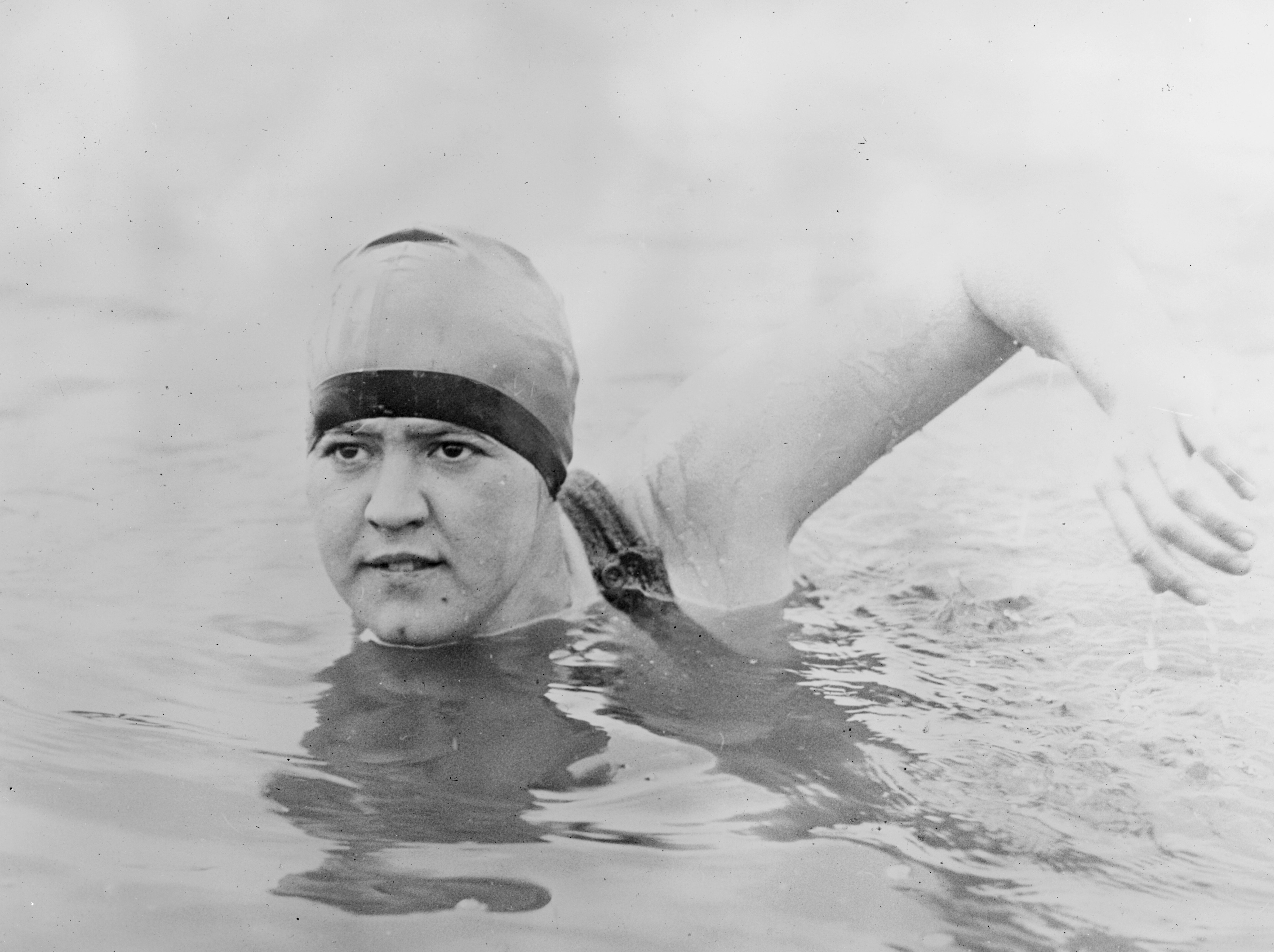
Trudy Ederle’s Story
When Gertrude “Trudy” Ederle swam across the English Channel in 1926, she wasn’t just racing the tides. She was rewriting what women were believed to be capable of.
Fourteen hours and thirty-one minutes after she entered the icy waters off the coast of France, she stepped onto the shore in England. She was the first woman ever to do it, and faster than any man before her, by a lot!
Trudy was born in 1905 to a world that minimized the efforts of women. In trying to “protect” women, the prevailing thought was that women should be sheltered and not allowed to participate in activities that would challenge them. The reasoning was that women were delicate. Raising their heart rate might cause their heart to explode.
In addition to that, women were viewed as possessions and temptations. This made swimming in public very difficult. Women were often arrested for showing their legs on beaches. Scandalous!
Trudy Ederle contracted the measles at the age of 5. She wasn’t expected to live. Her stubbornness in survival led to her incredible success in swimming events from 1921-1925, breaking 29 national and world records, competing in the 1924 Olympics in Paris, France and finally successfully swimming the English Channel in 1926.
“I love to row a boat or to paddle around in a canoe. I love basketball and all the things you do in a gymnasium. I love, love dancing, but swimming is the best of all. I think it’s the most splendid sport in the world. It develops you all over. Not just one or two sets of muscles. It improves your general health. I never really was ill. But I’ve been ever so much better since I took up swimming. It strengthens your lungs and tones up your nerves. And it’s such a clean sport.”
Trudy Ederle
She even survived a poisoning by her own coach in her first attempt at swimming the English Channel in 1925. Shocking!
But what made Trudy different wasn’t just her strength. It was how she approached the challenge.
There’s a lot we can learn from the way she trained, the people who supported her, and the mindset she brought to the water. Here are a few lessons from Trudy’s story that can help each of us swim our own “channel” — whatever that looks like.
1. Break Big Things into Smaller Pieces
Trudy’s first coach, Louis Handley, had a revolutionary approach to teaching swimming. He didn’t throw his students into the deep end. He broke every movement into small, learnable parts.
Before they even got in the water, he had them practice on land; breathing deeply, moving their arms in slow motion, bending at the waist to mimic a stroke. Then he’d have them practice floating before kicking, kicking before stroking, and stroking before breathing.
Each skill was layered on top of the next.
That’s how mastery works.
When we face a big goal — whether it’s running a business, learning a new skill, or parenting through a hard phase — we sometimes want to do it all at once. But progress happens one deliberate piece at a time.
Break it apart. Learn each motion. Put it together slowly.
That’s how you build strength — and confidence — that lasts.
2. See It Before You Do It (Visualization)
Before Trudy ever stepped into the English Channel, she saw herself doing it.
Visualization isn’t just daydreaming — it’s mental training. When we imagine something vividly enough, our brains activate the same neural pathways as if we were actually doing it.
That means when you visualize yourself staying calm in a hard conversation, performing with confidence, or reaching a new goal — your brain is rehearsing success.
This is what Olympic athletes, NBA stars, concert performers, and chess masters do. You can do it too!
3. Find Your “Flow”
“The other girls swam to get back to land, but Trudy swam to get away from everything. And in doing so, out in the water she found her own, true self. The place where she felt most comfortable. Where she did not think or worry, but simply felt the water holding her up and pushing her along.”
Glenn Stout – author “Young Woman and the Sea”
In the water, Trudy wasn’t trying to prove anything. She wasn’t competing or worrying. She was simply being.
That’s what psychologists call flow — the state of total absorption in what you’re doing. It’s when you lose track of time and self-consciousness and everything just clicks.
Flow happens when challenge meets skill. Not too easy, not too hard — just enough to stretch you without snapping you.
To find your flow:
- Eliminate distractions. Silence the noise around you.
- Set clear goals. Know what you’re doing and why.
- Immerse yourself. Focus on one thing at a time.
- Enjoy the process. Flow can’t be forced — it’s found in love for the moment itself.
Trudy didn’t swim to win. She swam because it was who she was.
When you find something that connects you to yourself like that — keep swimming toward it.
“I just did the best I could and I never thought of winning. I guess I swim as easily as I breathe or walk, and I think it ought to be just as natural for everybody. The scientists say we were all water animals to begin with. Then why shouldn’t we go back, now and then to our first home, the ocean.”
Trudy Ederle
4. Be Supported, and Support Others
Trudy’s sister Meg was her biggest cheerleader. When Trudy doubted herself, Meg reminded her of what she’d already accomplished.
Meg convinced her sister that she was indeed that good! That she could out swim her competitors and that she could, in fact, be the fifth person and first woman to swim across the English Channel. She was on the boat and even jumped in the water to swim with her and encourage her.
Every dreamer needs a Meg.
We all need people who remind us of who we are when we forget, who steady us when the water gets rough, and who celebrate with us when we reach the other side.
And sometimes, we get to be the Meg — cheering someone else on, believing for them until they can believe for themselves.
Conclusion
Trudy Ederle once said,
“To me, the sea is like a person. Like a child that I’ve known a long time. It sounds crazy, I know, but when I swim in the sea, I talk to it. I never feel alone when I’m out there.”
Trudy Ederle
Maybe that’s the real secret to her success.
She didn’t fight the water — she befriended it.
Whatever your “Channel” looks like — whether it’s a goal, a relationship, or a dream — remember Trudy’s rhythm:
- Break it down.
- See it first. (Visualization)
- Find your flow
- And swim with those who cheer you on.
Becky Brouwer’s very imperfect performance of the 1st Movement of the Haydn Concerto No. 11 in D Major. Not always in “flow”, but it is an attempt!
Visualization: The Power of the Movie Theater in your Mind by Ballispsych

The Talent Code by Daniel Coyle

Harry Potter and The Prisoner of Azkaban by J.K. Rowling

Young Woman and the Sea by Glenn Stout
Young Woman and the Sea on Disney Plus
Leave a Reply to What Fanny Bullock Workman Taught Us About Courage, Money, and Marriage – Sendy MomCancel reply