
Bonus Episode #022 – Julian of Norwich
Finding “All Shall Be Well” When Nothing Feels Well
Julian of Norwich was born around 1342 in England. She was not a queen, a noblewoman, or a famous teacher. She was, by her own description, “a symple creature unlettyrde leving In deadly flesh“— a humble woman living in one of the most devastating centuries in human history. And yet she wrote what scholars believe is the first book authored by a woman in the English language. Her words have survived wars, revolutions, and the burning of libraries. And they are more needed now than ever.
“This revelation was made to a Symple creature unlettyrde leving In deadly flesh”
Julian of Norwich

A World on Fire
To understand Julian, you have to understand the century she lived in.
The Black Plague arrived in England when Julian was about six years old. By the time it had run its course, it had killed between a third and half of the entire European population. Entire families, entire villages, simply gone. And then it came back again when she was sixteen.
Historians believe Julian may have lost a husband and children to the plague. She had already been shaped by profound loss before she turned twenty.
On top of this, the world she inhabited was not kind to women. Women were not allowed to teach theology. They were not recognized as writers. They were to be silent. The Church of Julian’s day was ruled by what I can only describe as a harsh, judgmental spirit — threatening people with hellfire and condemnation.
This is the world Julian was born into. And this is the world she had the courage to speak love into.
The Prayer That Changed Everything
Julian had a habit of praying for things that most of us would be afraid to ask for.
She prayed for three things:
First, she wanted to truly feel the suffering of Christ — not just know about it intellectually, but enter into it.
Second, she asked for a sickness so severe she would feel she was dying — believing it would purge away everything in her that wasn’t surrendered to God.
Third, she prayed for three spiritual wounds: contrition, compassion, and a longing after God that would never leave her.
That last one is the one that stayed with her for life.
On May 13, 1373, when Julian was thirty years old, that prayer was answered. She became gravely ill. Her priest came. Her family gathered. Last rites were read.
And then, she had a revelation. 16 of them to be precise.
From 4 in the morning until 9, and with one final vision that night, Julian received sixteen “shewings” of Jesus Christ. She saw His suffering. She saw light and color. She heard words spoken to her soul. And woven through all of it was a single thread that would define the rest of her life:
“All shall be well, and all shall be well, and all manner of thing shall be well.”
Julian of Norwich
The Hazelnut and the Love That Holds All Things
One of the visions I find most beautiful is this one.
Julian was shown something small in the palm of her hand — the size of a hazelnut. And she was told: “This is all that is made.”
She marveled at how something so small could survive. It seemed like it might simply fall away into nothingness. And she received this answer: “It lasts, and ever shall last, for God loves it.”
“In this little thing I saw three properties: the first is that God made it; the second, that God loves it; and the third, that God keeps it.”
I have read that passage a dozen times and it still takes my breath away. Everything that exists — all of creation — is as fragile as a hazelnut. And it is held in existence by love. Not by force. Not by rule. By love.
This was Julian’s anchor in a century of catastrophe. And I believe it can be ours too.

The Courageous Choice to Stay Still
After her recovery, Julian made a decision that might surprise you.
She became an anchoress.
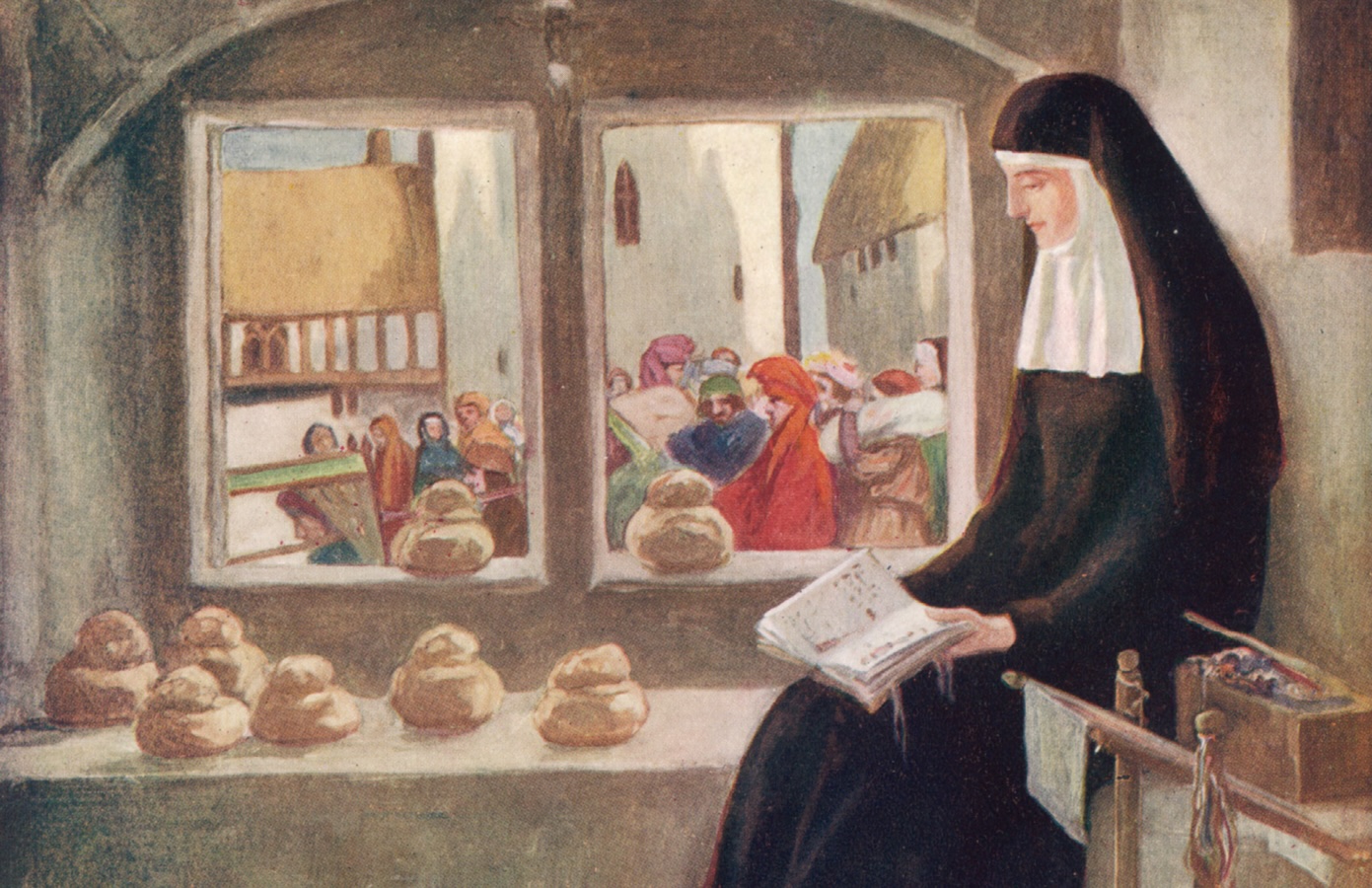
An anchoress was a woman who voluntarily entered a small room attached to the wall of a church — and never left. There was a ceremony that was, essentially, a funeral. Julian was sealed in. Last rites were spoken over her. To the world, she was dead.
She lived in that cell, praying and writing, for forty to fifty years until her death.
Now, I want to gently challenge our instinct to see this as giving up. Because I think it was the opposite.
In a world where women who spoke of visions could be accused of heresy, an anchoress was protected by the Church. She had legal standing. She had access to books. And people came to her — through a small window in her cell — to ask for guidance. She had real influence.
Julian was strategic. She found the one space in her world where a woman could think freely, write truthfully, and be heard. And she took it.
Courage doesn’t always look like marching. Sometimes it looks like rooting yourself so deeply in one place that nothing can uproot you.
The Theology That Was Almost Too Dangerous to Write
Here is the part of Julian’s story that I find most courageous.
What she wrote contradicted the dominant theology of her day.
She wrote that God does not have wrath toward His children — only toward sin. She described God watching humanity the way a loving Lord watches a servant who has fallen into a ditch while running an errand: not with anger, but with grief and tenderness and the desire to bring him home.
She wrote about God as our Mother as well as our Father:
“As truly as God is our Father, so truly is God our Mother.”
Julian of Norwich
She wrote that sin itself serves a purpose — not because sin is good, but because the experience of falling, and being found, deepens our love for God:
“It behoved that there should be sin; but all shall be well, and all shall be well, and all manner of thing shall be well.”
Julian of Norwich
She was careful. She always affirmed her loyalty to the Church. But the heart of what she wrote was a quiet revolution. A theology of mercy and love in a world preaching fear.
I don’t know about you, but I need that theology. Because when the world feels heavy, the last thing I need is a God who is watching me fail and keeping score.
Julian’s God is one who says: “I shall make well all that is not well. And thou shalt see it.”
The Women Who Kept Her Words Alive
Here is a detail I can’t stop thinking about.
Julian finished writing her long text sometime around 1410–1420. The first published copy didn’t appear until 1670. That is more than two hundred years later.
Why? Because her work was dangerous. When Henry VIII’s Act of Supremacy in 1534 dismantled the Catholic Church in England, most manuscripts were seized or destroyed.
But nine Benedictine nuns fled to France, taking what they could with them. They transcribed portions of Julian’s work. They kept it alive.
And then the French Revolution threatened to destroy even that.
Julian’s words survived because women — across centuries — decided they were too important to let disappear. They copied them in secret. They carried them. They preserved them with no promise of recognition.
That’s pretty sendy!
And now we get to read them.
What Julian Teaches Us About Brave Living
Julian never set out to be brave. She set out to be close to God. But in that pursuit, she did things that required tremendous courage. And I think her life offers us a few gifts.
Stillness can be a form of courage. Julian spent thirty years in a single room. She didn’t rush. She didn’t publish her visions immediately. She sat with them for twenty years before she felt she understood them enough to write the full account. In a world that rewards urgency, choosing to slow down and go deep is countercultural, and sometimes revolutionary.
You don’t need credentials to speak truth. Julian called herself a simple, unlettered creature. She wrote anyway. Her insights have outlasted centuries. What truth are you sitting on, waiting until you feel “qualified” enough to share it?
Being strategic is not the same as being cowardly. Julian worked within a system while stretching it from the inside. She stayed in bounds while saying things that pushed every boundary. There is wisdom in understanding your context and choosing your battles carefully.
Choosing love is always an act of courage. Julian’s proclamation that “all shall be well” was not wishful thinking. She wrote those words surrounded by plague, loss, and isolation. She chose to believe in the love of God when the world offered no proof of it. That kind of faith is not passive. It is fierce.
Her Most Famous Words
“Wouldst thou learn thy Lord’s meaning in this thing? Learn it well: Love was His meaning. Who shewed it thee? Love. What shewed He thee? Love. Wherefore shewed it He? For Love. Hold thee therein and thou shalt learn and know more in the same.”
Julian of Norwich
Love. That is what she was buried alive to say. Love is the meaning. Love is the answer. Love is what holds the hazelnut — and you — in existence.
I want to live more like Julian. Not in a cell, necessarily. But with that same rootedness. That same willingness to believe in something beautiful even when the evidence is hard to see.
Whatever you are facing this week — I leave you with her words:
“All shall be well, and all shall be well, and all manner of thing shall be well.”
Julian of Norwich
Mentioned in This Episode

Revelations of Divine Love by Julian of Norwich — Julian’s own writing, available in modern translations
Dr. Janina Ramirez — Julian of Norwich: The Search for the Lost Manuscript — BBC documentary on Julian’s story and surviving manuscripts

Margery Kempe — The Book of Margery Kempe — The first autobiography written in English, by a woman who visited Julian before Julian’s death

Man’s Search for Meaning by Dr. Viktor Frankl — Holocaust survivor and Professor of Psychology on finding meaning in despair
Julian of Norwich (c. 1342 – c. 1416) was an English mystic, theologian, and anchoress. Her work “Revelations of Divine Love” is considered the earliest surviving book written in English by a woman.


Leave a Reply