
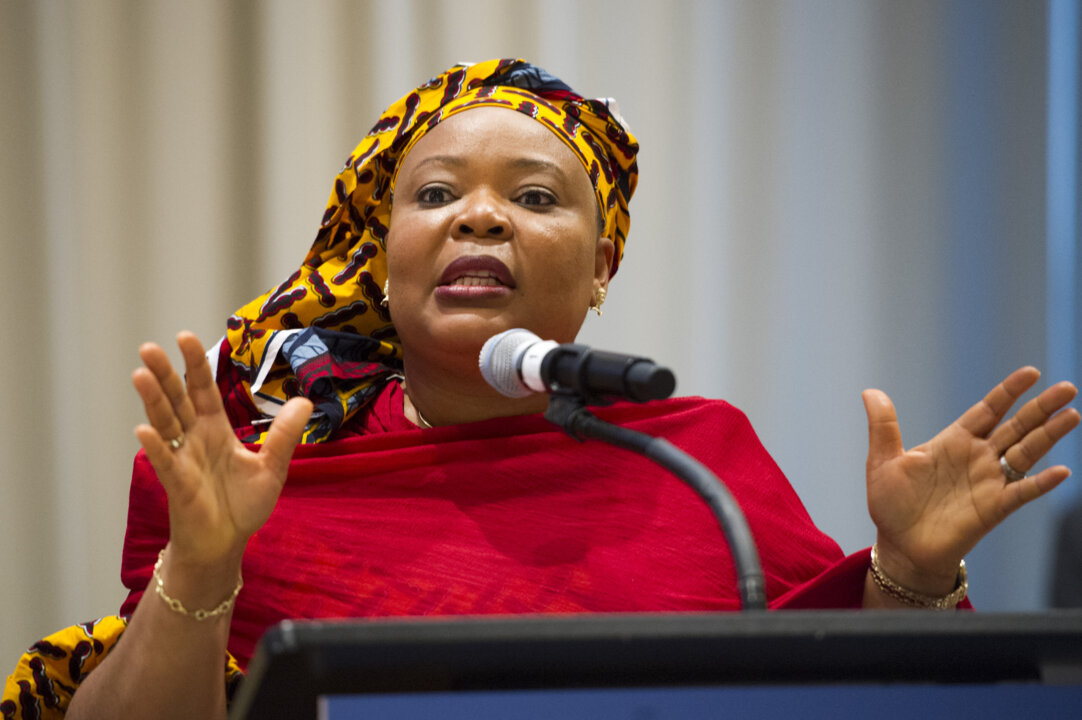
Leymah Gbowee; Social worker, peace activist, and 2011 Nobel Peace Prize laureate
Sendy Spotlight #023 – Mighty Be Our Powers: The Courage of Leymah Gbowee
Leymah Gbowee grew up in Liberia during fourteen years of on-and-off civil war — a young mother in an abusive relationship, sitting in a hospital hallway because she couldn’t pay a bill, sinking into a depression she described as feeling “too hard to move.” She went on to help lead a nonviolent women’s movement that ended the war, and in 2011 she won the Nobel Peace Prize.
I read her memoir, Mighty Be Our Powers, after meeting her at a dinner for Bellwether International. Her story hasn’t left me since. Here are four lessons in courage, straight from her own words.


1. What Are You Running From?
“We’d been pushed to the wall and had only two options: give up or join up to fight back. Giving up wasn’t an option.”
Leymah Gbowee
Before Leymah became a peace activist, she spent years just trying to survive — an abusive marriage, poverty, a depression so heavy she wrote that she’d rather just stay stuck than move. The turning point came from a refugee she was counseling, who told her plainly: what else was there to do but keep fighting?
I think about my own small version of this. I once gouged a trench into our hillside with a tractor and immediately ran to my husband in tears, telling him what a horrible wife I was. Pulling up wads of grass afterward, I realized the tears weren’t making me feel better — they were keeping me small. I hadn’t ruined anything but a lawn. I was just choosing to stay a victim instead of standing up and fixing it.
The lesson: Running from a mistake or a hardship feels protective, but it keeps you stuck. Courage starts the moment you stop running and start standing.
2. Equality Doesn’t Mean Equal
“I see myself as a messenger: my job is to take the stories of little girls… and make them heard on the global stage.”
Leymah Gbowee
Leymah didn’t need everyone around her to have lived her exact life. She needed people willing to treat her as an equal. Abigail Disney, the documentary filmmaker who told Leymah’s story in Pray the Devil Back to Hell, came from privilege and comfort — but she showed up with respect, not pity, and that was enough to build something real together.
I feel that tension too. When I read stories like Leymah’s, I sometimes think, who am I to speak into this? But Gloria Steinem once said there are many flowers in a garden, and the bouquet isn’t complete without any one of them. You don’t need matching circumstances to treat someone as your equal — you just need to actually do it.
The lesson: You don’t have to have lived someone’s exact story to have a role in it. Equality isn’t about sameness — it’s about respect.
3. It Sometimes Takes Another Person to Lift You
“My fear, depression and loneliness was finally totally wiped away. Others who felt the way I did stood beside me; I wasn’t alone anymore.”
Leymah Gbowee
A friend named Tunde once refused to accept Leymah’s excuses about going back to school. “Yes, you can,” he told her. “You have too much potential. Don’t throw it away.” That belief, and later the community of women she led, pulled her out of a darkness she couldn’t climb out of alone.
I’ve had my own Tunde. My husband, Robert, has believed in me since the beginning of our marriage, even when I couldn’t see myself as his equal. Through my life coach training with Jody Moore, I’ve started to notice how I’ve sabotaged myself for years — and how much faster I can bounce back now that I’m not doing it alone.
The lesson: None of us climbs out of our hardest seasons by ourselves. Let the right people in, and become that person for someone else.
4. Reconciliation Is How You Get Free
“It’s a personal choice whether or not to let go… but you can’t move forward until you break that chain.”
Leymah Gbowee, on the teaching of Hizkias Assefa
Leymah’s teacher described unforgiveness as a weight that chains you to the very person who hurt you, keeping you in a valley while the mountain of peace waits above. Leymah has spoken plainly about Charles Taylor, the leader whose war upended her country — she doesn’t excuse what he did. But she’s worked to reconcile with God, herself, her environment, and even him, because the chain was hers to break.
I still carry people with me that I haven’t fully let go of. It may take a lifetime. But I’ve noticed the more love I send toward the people who’ve hurt me, the less power they actually hold over me.
The lesson: Forgiveness was never about setting them free. It’s about setting yourself free to climb.
Want the whole story — Liberia’s history, the women in white t-shirts who locked arms around a peace conference, and how it all led to a Nobel Prize? Listen to the full episode on Sendy Mom, out now.
FULL TRANSCRIPT
Becky Brouwer (00:00)
Before we start, I want you to close your eyes for a second, unless you’re driving.
close your eyes for a second, unless you’re driving. Imagine a world where children as young as eight are carrying AK-47 rifles down your street, where young girls are used for sex daily just to survive one more day.
Where you don’t know when your husband or your son walks out the door if you’ll ever see them again, where the sound of gunfire is simply part of your Tuesday.
That was Leymah Gbowee’s Liberia. And what she did inside that world is one of the most courageous and extraordinary stories I have ever heard. I actually got to meet Leymah in person at a dinner for Bellweather International. I was introduced by my friend Rachel Minor.
Who you might remember from a past episode about her work with Bellwether, Women Doing Something. Leymah was sitting with her friend Thelma, and I was struck by how much love they had for people, any people, no matter their skin color or their bank account. I went home and I read her memoir, Mighty Be Our Powers, and it hasn’t left me since. This woman has earned her Sunday status through deliberate practice of stepping into her power.
Today I want to walk you through her life around four lessons in courage. And I’m gonna tell you where my own life has intersected with each one because I don’t think these lessons belong only to her. I think they belong to all of us.
Before we get to the lessons, I wanna give you some context because Liberia’s history explains a lot about the world Leymah was born into, and it’s stranger and more tragic than most of us learned in school.
Liberia was founded in 1822 by freed black slaves from America, brought over by an organization called the American Colonization Society. These freed settlers called themselves Americo Liberians, and instead of building a nation alongside the people who already live there, the many indigenous tribes of the region, the Americo-Liberian settlers set themselves up as an elite ruling class.
Kind of interesting given the oppression they had just suffered and escaped from in America. For over a hundred years, one political party made up almost entirely of these settlers, the true Whig Party, ran the entire country. Indigenous Liberians, the majority of the population, were largely shut out of the government, wealth, and power in their own land. That kind of imbalance doesn’t last forever. So in 1980,
A low-ranking indigenous soldier named Samuel Doe led a coup, stormed the executive mansion, and killed the president. For the first time, an indigenous Liberian held power. But Doe’s rule quickly became its own kind of brutal, favoring his own ethnic group and crushing others. Then on Christmas Eve, 1989, a rebel leader named Charles Taylor invaded Liberia with his own armed group. What followed was
Fourteen years on and off of civil war. Doe was captured and killed in nineteen ninety. Taylor eventually became president himself in nineteen ninety-seven, an election where many Liberians voted for him simply out of fear. The saying at the time was that he was the devil you know. The war dragged on, more than two hundred thousand people died, a quarter of the population was displaced, and a generation of Liberian children.
Boys as young as eight were drugged and armed and turned into soldiers. This is the world Leymah Gbowee grew up in. And I’ve actually painted a bit of a rosy picture. If you want all the details, go and read her book.
This is the world she would eventually stand up against, not with a weapon, but with a white t-shirt and a willingness to sit on bare ground in the rain and the heat day after day with over 2,000 of her Liberian sisters beside her.
Here’s the first question Leymah’s life keeps putting in front of me. What are you running from? And what will it take for you to stop running and start standing up?
Before Leymah was a peace activist, she was just a girl watching her country fall apart while living through her own private war at the same time. She wrote about the transition from innocence to fear with words I just can’t stop thinking about. When you move so quickly from innocence to a world of fear, pain, and loss, it’s as if the flesh of your heart gets cut away piece by piece like ham. Finally, there is nothing left but bone.
She became a mother young in an abusive relationship with children to feed and no money to feed them. She once sat in a hospital hallway for a week with a premature baby because she couldn’t pay the bill, until a stranger in a private room quietly gave her some diapers and a doctor she’d never met paid what she owed.
She let life happen to her, like so many of us do. We willingly take the victim role because it is so easy and requires little effort. And she fell into a depression so heavy, she wrote, You feel so helpless, so drained, that no matter how bad the place you find yourself, you sink into it thinking, It’s too hard to move. I’ll just stay here. She described the particular cruelty of depression like this.
How it traps you inside yourself, how you lose the energy to help even the people you love, how you start to hate yourself for that failure. And the hate makes you sadder, and the sadness makes you more helpless, and the helplessness fills you with more self-hate. If you’ve ever felt that pull, you know exactly what she meant. The turning point came through her work counseling displaced families and former child soldiers.
She met a refugee from Sierra Leone who, after everything she’d survived, was talking about going back home. Leymah asked her, How could you possibly want to go back? The woman said simply, What else shall I do? Allow them to win? That sentence changed everything for Leymah She turned it over in her mind for years afterwards because in that moment she understood something. This woman’s personal tragedy wasn’t just personal, it was
National. It was political. Her pain wasn’t just hers to carry it, it was connected to something bigger. And that meant the response to it had to be bigger too. She later put it this way: We’d been pushed to the wall and had only two options: give up or join up to fight back. Giving up wasn’t an option. So she stopped running. In 2002, Leymah helped found the Women of Liberia Mass Action for Peace.
the idea was radically simple. Christian women and Muslim women standing together refusing to let their religious differences be used against them the way the war had divided everyone else. They gathered day after day in a field beside a fish market in Monrovia, a place Charles Taylor’s motorcade passed every single day on his way to the executive mansion.
Dressed in plain white t-shirts, the color of peace, holding signs, singing, praying, refusing to move, impossible for him to ignore. The women pressured Taylor directly until he agreed to meet with them, and Leymah stood in front of him and demanded that he attend peace talks with the rebel factions in Accra, Ghana. He went. And when the talks dragged on for weeks with no resolutions while the war kept raging back home,
Leymah and roughly 200 women did something almost unthinkable. They surrounded the conference hall with linked arms refusing to let the delegates leave until the peace agreement was signed. When security tried to remove her, Leymah threatened to take off her clothes in protest, a devastating curse in that culture.
One of the most shaming things a woman could do to the men around her. It worked. One of the mediators, a Nigerian general, reportedly said, The peace hall has been seized by General Leymah and her troops. A peace agreement was signed weeks later in August of 2003. Charles Taylor went into exile. After 14 years on and off, the war was over. The women of Liberia hadn’t done it with weapons. They’d done it.
By refusing to leave a room. I want to tell you about my own much smaller version of owning power, one that has nothing to do with war, but everything to do with the instinct to run instead of stand. Not against outside persecution, but against really my own self-hate. A while back, I took our tractor out to move some dirt on a hillside near our barn.
We have this beautiful stretch of grass that runs up from the barn. And as I was driving up the hill, I forgot to raise the tiller that was attached to the back. It gouged a trench in the grass the entire way up until the tractor finally stopped. When I realized what I’d done, I did what I’ve done my whole life in moments like that. I went straight to my husband and cried.
I told him what a horrible wife I was, how I’d ruined his lawn and wrecked his tractor. He didn’t say much. He just went out to fix it. As I helped him pull up wads of grass and dirt, I started wondering why I had that reaction. It just felt normal to cry and to think of myself as the trouble to everyone’s life. It just felt like the right way to handle it. I realized that I didn’t actually feel better with this reaction. I felt small and stupid.
Like I didn’t matter. Like I was always the one making mistakes. I’d slip straight into a victim mentality that some part of my brain wanted to insist was protecting me. In that moment, I decided I didn’t want to do that anymore. My husband has always treated me as an equal from the very beginning of our marriage. I was the one who had trouble seeing myself that way. So instead of thinking I ruined everything and I’m a horrible wife.
I decided to let myself think I messed up our yard with our tractor. That’s it. That’s all it was. It changed everything. Once I could see it as a mistake instead of proof of my own worthlessness, I didn’t need to blame anyone else for being upset with me. And I didn’t need to be furious at myself either. The gouge marks in that hill are still there. So is the grass that’s growing back over them.
And every time I see it, I remember I am in charge of my own confidence. Nobody put me in that helpless place but me. And when I’m ready to take my power back, it’s right there waiting. Leymah’s version of that moment was infinitely harder than mine, but the shape of it is the same. The instant you stop treating your pain as proof that you’re helpless and start treating it as something you can act on, everything changes.
Here’s a second lesson, and it’s one that I wrestle with every time I read a story like Leymah’s. Equality doesn’t mean equal. When I read about the kind of suffering Leymah lived through, I sometimes feel a wave of helplessness. How could I possibly relate? Won’t she, won’t anyone who’s actually lived that see me as some comfortable outsider with no business speaking into her story?
I feel guilt for my own good life, and that guilt can quietly talk you out of doing any good at all. Is it is its own kind of victimhood and it keeps us from a lot of good we could be doing. But here’s what Leymah’s story in teaches instead. Everyone has a role to play. She and women like her are the ones who have lived it. And that gives them a kind of access no outsider has.
They can relate to survivors and pull things out of them that nobody else could. But that doesn’t mean the rest of us are disqualified. It just means our role looks different. Take Abigail Disney, who produced the documentary Pray the Devil Back to Hell about Leymah and the women of Liberia. Abby grew up in privilege, wealthy, white, a nice apartment in New York City, a husband and four kids.
Leymah wasn’t especially impressed when they first met, but Abby didn’t try to prove she understood Leymah’s suffering. She simply treated her as an equal with respect and love. That was enough to build something real together. There’s another piece of this worth mentioning. Leymah has talked about her how frustrated she was with the official UN peacekeeping mission in Liberia.
when they would make decisions about disarming and reintegrating fighters without ever consulting the local women who actually understood their communities. Leaflets about disarmament programs were dropped on villages where much of the population couldn’t read. And when confused, desperate people showed up expecting help. The aid workers ran out of resources and fighting broke out again. The people closest to a problem usually understand the solution best.
Real help listens first and treats the people is trying to help as the experts on their own lives. Stay in your lane because without it, others won’t know where to go. I think about something Gloria Steinem once said, that there are many different flowers in a garden, and every one of them is beautiful and necessary. And the bouquet wouldn’t be complete if even one were missing.
Years ago, at a library book sale in Brisbane, Australia, I wandered through a hull of hundreds of thousands of books and found myself in the biography section, marveling at a row after row of people I’d never heard of, and realizing that every single one of them had done something in their life important enough that somebody sat down and wrote a book about it. Leymah herself said it best. She called herself a messenger.
My job is to take the stories of little girls from Basa and Bong counties, from Ghana and Congo and Sierra Leone, and make them heard on the global stage. We all have a part to play. You don’t need matching circumstances to treat someone as your equal. You just need to actually do it. Nothing makes you better or worse than another human. I love Leymah and the
Thelma’s exercise of writing everyone’s identity, lawyer, mother, daughter, doctor, shoe salesman, rich, poor, onto papers and putting them away into a big box. She gave them one identity woman. If we can regard everyone around us as the same, it will go a long way in recognizing what we have in common instead of looking for the differences.
The third lesson is one of the most tender parts of Leymah’s story.
Sometimes it takes another person to lift you out of the dark. In her darkest season, it wasn’t a grand gesture that pulled Leymah forward. It was a friend and later a lover named Tunde who refused to accept her excuses about going back to school. Every time she told him a reason it was impossible, he pushed back. Yes, you can, he’d say, No, you haven’t, when she said she’d lost her old abilities.
Yes, you will, when she said there was no chance she’d succeed. You have too much potential, he told her. Don’t throw it away. You know this isn’t the life you want for yourself. She also had a boss, a pastor named Reverend Bartholomew She called him BB, who wouldn’t let her just complain about the state of the world. He’d hand her a newspaper article and ask her what she thought. Then he’d push further.
Why were things this way? How did we get here? What could actually be done about it? He was training her mind to move from helplessness to strategy. And that training mattered enormously for what came next. And she leaned hard on her sister Geneva, who became like a co-parent to her children. Leymah would go to work and study, and Geneva became, in her words, the manager of the house.
As painful as it is, we need people in our lives like Thelma, who pushes Leymah intellectually, saying things like, You’re using only 50% of what you have. Having somebody like that to trust with your ideas and help you find your strength is priceless. Later, that same kind of lifting happened on a much bigger scale. Inside the movement itself, Leymah worked with women on shedding the weight. Women in WIPNET.
Would sit together in a circle, holding a single can lit candle, and tell their story out loud, uninterrupted, while everyone else simply listened. Some of these stories they had never shared before out loud. She wrote that women are trained to be sponges, to absorb the trauma of their husbands, their children, their whole community, and to hold it all in silence because sharing is seen as weakness.
Have you ever felt like you were carrying the weight of so many? Holding in that kind of misery, Leymah says, is just as crippling as holding on to rage. The candle circle gave women a way to finally set it down. And Leymah herself was lifted by that same community. She wrote about the moment the loneliness of her whole life was finally wiped away.
Not by a single person this time, but by a room full of women who felt the way she did. My fear, depression, and loneliness was finally totally wiped away. Others who felt the way I did stood beside me. I wasn’t alone anymore, and I knew in my heart that everything I had been through, every pain had led me to this point. Self-hate has been a familiar companion of mine for a long time. I do a lot.
But I still feel guilt for the things I’m not doing. I’ve asked myself for years, why is it that when I make a mistake or disappoint someone, my instinct is to slip into a closet, cry, and just want to disappear? I’m getting better getting better at this slowly. My husband Robert has been a huge part of that. He’s believed in me since the beginning of our marriage and he’s learned to work with me and what I call the drama, which isn’t really a bad word. We all have drama.
Having someone see it from a new perspective helps take the heaviness out of it. And that’s exactly what Robert does for me. Through my life coach training with Jody Moore, I’ve also started to notice the ways I’ve quietly sabotaged myself for years. And I’m learning to balance back from a hard moment much faster than I used to. And I have all of you. Sometimes I feel like this podcast is a place for me to just shed the weight. Thank you for being there for me.
But it it is also a place for me to join with a community to cheer everyone else on their path to becoming more courageous, more sendy. In fact, this podcast would never have come to be without my sister in law, Brooke Dodds. She continues to support me. When I told her about my idea for the podcast, and I wasn’t quite sure I wanted to do it, she was really supportive. She had so many ideas for me.
I actually started believing in myself. It has meant the world to me when she or another listener lets me know they are listening, learning, and being transformed by these stories. None of us gets through our hardest seasons alone. We just need to let the right people in and then become that person for someone else.
The last lesson is the one I think matters most for the long run. Reconciliation is how you get free.
Leymah studied under a peace s scholar named Hizkias Assefa who taught that the true reconciliation requires repairing four relationships with God, with yourself, with your environment, and with the person who wronged you. He described it like this You are standing in a valley of misery, a place of anger, depression, and hurt. And the person who hurts you is standing there with you. If you haven’t forgiven them, you’re chained to them.
Every time you see them or even think of them, your heart still skips a beat. If the trauma was severe enough, you dream of revenge. Above that valley is a mountain, peace and prosperity, the life everyone wants to reach. But you cannot climb it while you’re still dragging the weight of that person you haven’t let go. As Leymah put it, it’s a personal choice whether or not to let go, but you can’t move forward until you break that chain.
Leymah later studied restorative justice at Eastern Mennonite University, a completely different way to of responding to harm than punishment alone. In restorative justice, the offender takes real concrete steps to repair what they broke. The victim is restored, and then genuinely both people become contributing members of society again together. It’s a strikingly different vision than the one most of us grew up with, where justice means
Punishment and nothing more. Leymah has spoken publicly about Charles Taylor, the man whose war upended her country and her life. She said plainly in interviews that had he had a real chance to do good for his country and chose another path. She hasn’t excused what he did, but she’s also worked deliberately to reconcile with God, with herself, with her environment, and yes, even with him.
Not because he earned it, because she needed to be free to climb her own mountain. Leymah went on to earn a graduate degree in conflict resolution. And in 2011, she was awarded the Nobel Peace Prize alongside Ellen Johnson Sirleaf, who was the president of Liberia, and Dr. Kaman for in the Nobel Peace Committee’s words, her nonviolent struggle for the safety of women and for women’s rights.
full participation in peace building. She founded the Gbowee Peace Foundation in 2012, which works toward a reconciled Africa that recognizes the talents of people, regardless of gender or ethnicity, through a project she calls the Young Girls Transformative Project. She and her
Her team go into rural communities and simply create space, space for girls to unlock their intelligence, their passion, their leadership. As she puts it, when these girls sit, you unlock intelligence, you unlock passion, you unlock commitment, you unlock great leaders. They’ve worked with girls, some of whom walked in shy and now advocate for the rights of other young women themselves.
And through it all, she says her deepest desire and dream is simply to go home. My heartbeat is in Liberia, she wrote. I sleep, eat, and breathe breathe Liberia. After everything that’s happened, when I think of my country, I think of happiness. I have people in my own life I still carry around with me. Old hurts I haven’t fully set down. I’m working on it. It might take a lifetime.
But I’ve noticed that the more love I’m able to send toward the people who’ve hurt me, the less power they actually have over me. Forgiveness was never about setting them free. It’s about setting myself free to climb.
So four lessons from one extraordinary life. Stop running and start standing. Treat people as your equal, even when your stories don’t match. Let someone lift you and then lift someone else and break the chain so you can climb.
Leymah once wrote that everything she’d been through had led her to that moment, surrounded by women who wouldn’t let her be alone anymore. I believe that’s true for all of us. Our pain isn’t wasted. It can become the very thing that qualifies us to help someone else. Leymah didn’t want to be rescued and she didn’t wait for permission. She took her own grief and a room full of other women’s grief and turned it into a patch of bare ground by a fish market.
Where she sat day after day in the rain and the heat with her Liberian sisters beside her until an entire country’s future had to pass by and take notice. What are you running from? And what would it take for you to stop, take your place on the ground beside the people you love and stand up for what’s worth fighting for? One more thing before you go.
If Leymah’s story has you thinking about your own next season of courage, maybe even a senior mission you’ve been circling around but haven’t taken the leap on, I’m opening up a coaching program this fall to help you explore that decision and step into it as your most confident self. Details are in the show notes. Thank you so much for listening to the Sendy Mom podcast today. If this episode moved you, share it with someone who needs a little borrowed courage today. And
I’ll see you next time.
And, if Leymah’s story has you thinking about what your own “standing up” might look like, I want to mention something I’m working on. I’m launching a coaching program this fall for people considering a senior mission for The Church of Jesus Christ of Latter-day Saints — and for the very real fears that come with it. Leaving grandchildren behind. Worrying about pets, your home, your routine. Wondering if you and your spouse can handle spending 100% of your time together without driving each other crazy.
This 8-week program, for individuals or couples, is about more than just deciding whether a mission is right for you. It’s about changing how you see yourself, your purpose, and the disciple you’re already becoming — for the rest of your life. The first group begins September 21, at a significant discount for early sign-ups. If you’d like to learn more, email me at beckybcoaching@gmail.com.

For further listening:
🎧 Listen to the whole episode above, watch it on YouTube, or find it wherever you get your podcasts.
If you loved this episode, try:
Faith Robles – From Trafficking Survivor to Advocate: Faith’s Story
Ep 030 – Trixie Espinosa – How You Can Help End Poverty: From Crickets to Crops and Feeding the 7,000
Ep 024 – Rachel Miner – Women Doing Something! Teaching Love with Rachel Miner of Bellwether International
Mentioned in the Show:

Mighty Be Our Powers by Leymah Gbowee — her memoir, and the primary source for this episode

Rise, Girl, Rise: Our Sister-Friend Journey, Together for All — a picture book by Leymah and her longtime friend Gloria Steinem, on the power of sisterhood and collective action
The 2011 Nobel Peace Prize — Leymah Gbowee — official photo gallery and biography from NobelPrize.org, shared with Ellen Johnson Sirleaf and Tawakkol Karman

Leymah Gbowee’s Nobel Lecture, Oslo, December 10, 2011 — her acceptance speech, in her own words

Pray the Devil Back to Hell — the award-winning 2008 documentary produced by Abigail Disney, chronicling the Women of Liberia Mass Action for Peace
Leymah Gbowee: Unlock the Intelligence, Passion, Greatness of Girls — her TED Talk, TED2012

Gbowee Peace Foundation Africa — the nonprofit Leymah founded in 2012, expanding education and leadership opportunities for women and youth in Liberia (see also its U.S. partner organization, GPFA-USA)

Hizkias Assefa — peace scholar whose teaching on the four dimensions of reconciliation (God, self, environment, offender) shaped Leymah’s philosophy
Eastern Mennonite University — where Leymah studied restorative justice and conflict transformation
Liberian history context — Liberia’s 1822 founding by freed American slaves, over a century of Americo-Liberian rule under the True Whig Party, the 1980 coup led by Samuel Doe, and the rise of Charles Taylor beginning in 1989
Leave a Reply