
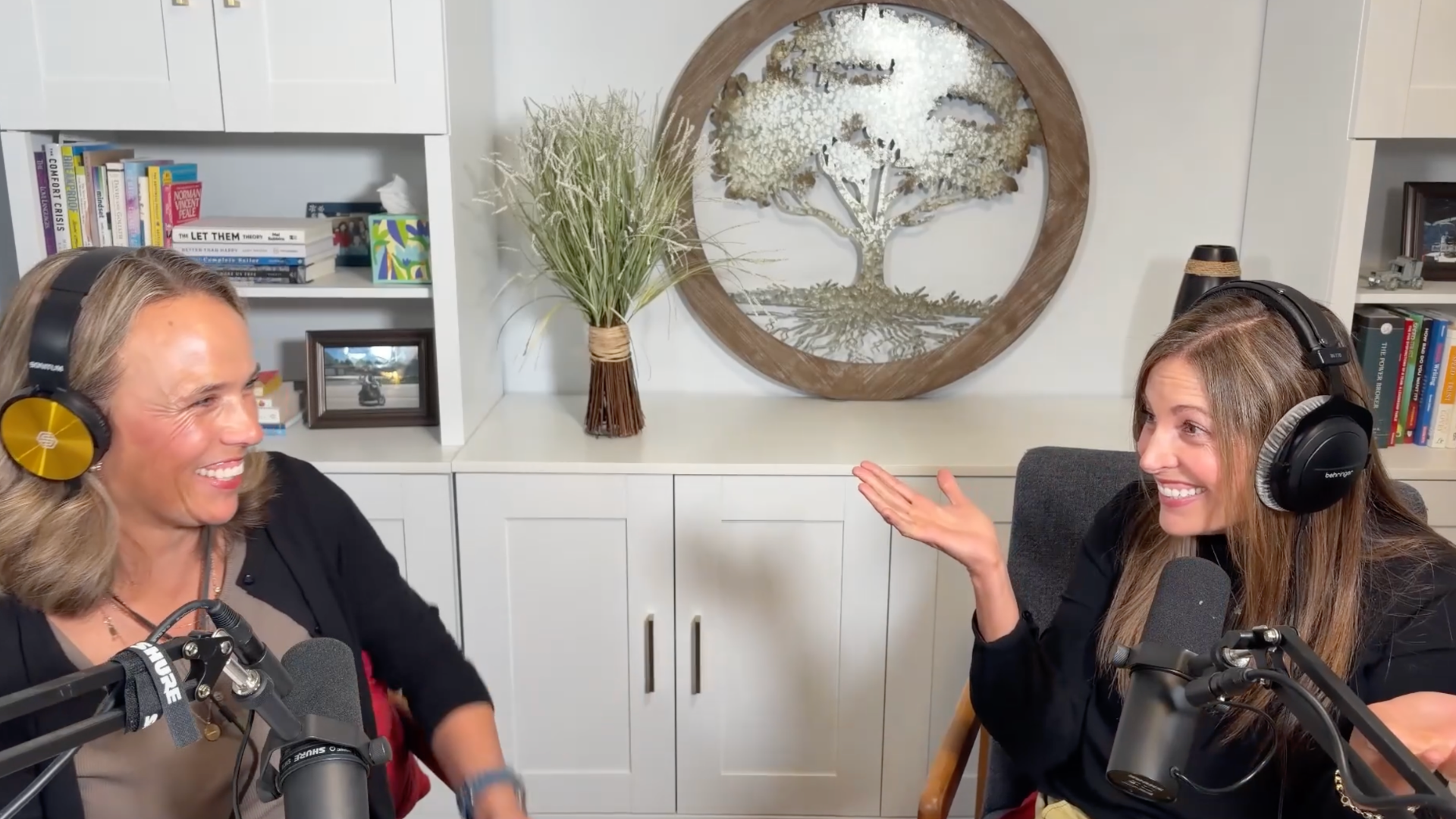
By Becky Brouwer | Sendy Mom Podcast, Episode 45
Episode #045: Tension, Release, and the Beautiful Mess of a Courageous Life — Christie Skousen
Christie Peery Skousen; International competition winner, master teacher, and visionary entrepreneur — building a legacy one pianist at a time.
Part 1
Part 2
There’s a moment in my conversation with Christie Skousen where she says something that stopped me in my tracks.

She’s describing the pattern of her life — the way she clings to a comfortable, mastered place, and then something blows it up. Her parents’ divorce. Her older brother dying of colon cancer at 48, leaving five children behind. Her own 26-year marriage ending. And she says:
“I literally felt like the planet that I existed on had been blown up and I was out in space with nothing to grab onto. Nothing. But you did have this — you had yourself, what you knew. So you try to go back to that. You gather and you rebuild and you build something new.”
That’s not a quote about music. But it is, in a way, completely about music. Because Christie Skousen has spent her entire life learning that the most important thing about any great performance — and any great life — is not the notes you hit. It’s what you do with the spaces between them.
Christie is the founder of the Peery Piano Academy and the creator of the Peery Method — a curriculum that has sent students to Peabody, Juilliard, Eastman, and conservatories around the world. She’s a pianists’ pianist, the daughter of the legendary Irene Peery Fox (who, true story, was performing at Carnegie Hall while pregnant with Christie), and a woman who started teaching piano at age nine to fund her own life. She’s a dear friend. And this conversation — all two hours of it — is one of my favorites I’ve ever recorded.
Here’s what she taught me about courage.


1. You don’t have to lead with your heart to show up bravely
Christie describes competitive classical piano as a brutal world. Judges are subjective. You can pour everything you have into a performance and walk away with nothing. Her older brother — literally a better pianist than Christie growing up — consistently lost to her in competitions. Not because she played better. But because she understood something instinctively that took her years to name.
“How I succeeded in competitions wasn’t because I love music. It’s because I wanted to prove I was better than you. I can do that all day long. If I went in vulnerable about how much I love music — and came on that stage and said, ‘this means everything to me and I’m going to show you who I am right now’ — there’s no way I would have done that. That’s terrifying.”
Christie is not recommending this as the healthiest long-term strategy — she’s clear that using competitiveness as armor has its costs. But she is saying something important: there are different parts of yourself you can draw on when you need courage. Sometimes the door to your brave thing is the competitive fire, not the tender heart. And that’s okay. You learn more as you go.
What it looks like for you: Think about the thing you’ve been avoiding because it feels too vulnerable. Is there a different part of you — the curious you, the competitive you, the “I will figure this out” you — that can walk through the door first while the tender part catches up?
2. The process is not the price you pay for the result. It IS the result.
Christie grew up in a household where practicing piano two hours a day was as non-negotiable as brushing your teeth. She started teaching at nine, paid for her own college, paid off her Peabody student loans in a year by teaching 50 students. The Peery Method she built — now taught online to teachers worldwide — is essentially a codification of what happens when you show up every single day and do the work with precision, patience, and a long view.
“Yes, that is the mantra of my life and all that Peery is about. The method that I wrote is just all about — if you follow the steps and do the work. If you do the work, you can do whatever. Even at an older age too.”
I teach my own 83-year-old mother-in-law, Ans Brouwer Who has gotten measurably stronger. At 84.
Christie isn’t just talking about piano. She’s talking about podcasting, parenting, building a business, healing a marriage, or learning to be a better human being. Any of it. The process is not something you endure on the way to the goal. The process is the whole thing. And if you can fall in love with the daily, repetitive, unglamorous showing up — you’ll never not be winning.
What it looks like for you: Where in your life are you waiting for the result before you enjoy the ride? What would change if you decided the daily reps were the point?


3. Life is made beautiful by its phrasing — tension, release, expansion, contraction
Midway through Part 2, Christie is describing the cycles of her life — the periods of mastery, then disruption, then rebuilding — and I offer her a musical analogy: it’s phrasing.
She lights up.
“Our life is filled with those phrases where it’s coming out and then back in. Black and white music — when you just tap it into a computer and play all the notes 100% accurately — it’s not beautiful. It’s not touching. It’s that phrasing and that shape that makes a life beautiful. The tension and release.”
This is the most quietly profound thing in the whole conversation. We are so conditioned to want stability — to find the formula, lock it in, and stay there. Christie is honest that she is this way. She would prefer to master one thing, stay on her throne, and feel great about it. But her spirit keeps saying: there’s more to you than this.
Every blow-up has eventually become an expansion. Every contraction has held within it something she needed. The divorce her parents went through at 23. Her own divorce at the end of 26 years. Her brother’s death. None of it is something she would have chosen. All of it has shaped the woman she is — a woman who now meets with single moms every week to help them rebuild their thinking, their identity, and their futures.
What it looks like for you: Where are you right now — in expansion or contraction? What is this phase building in you? What might you need to release in order to move into the next phrase?
4. Separate your identity from your children’s outcomes — and from your own past self
This is the one that hit me hardest personally.
Christie talks about moving to the Bay Area with a five-month-old and deciding she was done with piano. All that intensity — the six-hour practice days, the homeschooling, the laser focus, the drive — suddenly had nowhere to go. And it went toward her infant son. She was parenting like she was training a student. Scheduling, planning backwards, expecting perfection.
“I was approaching motherhood with him like I did my own practicing — like what I expected from my students. I had his whole future planned out in my head. I have a very sensitive first child. That intensity was not healthy for him.”
It took blow-ups — a second baby, returning to teaching, building her school — to learn to separate who she was from who her kids were becoming. We talked about this principle:
“I don’t take credit for the good things they do, and I don’t take the blame for the not-so-good stuff. Either way — it’s really them.”
I tell her about one of my kids who’s into homesteading and farming. One who diverges from me politically. One who has walked a different spiritual path. And instead of pulling them back to my vision, I’ve gotten curious. I ask: tell me about this. Why do you think this? What’s that like for you?
That takes some courage. Quiet, daily, unglamorous, beautiful courage.
What it looks like for you: Where have you fused your identity with the outcomes of people you love — your kids, your marriage, your work? What would it feel like to love them completely while releasing the outcome entirely?
A Few More Things Christie Said That I’m Keeping
On protecting kids from the brutality of competitive comparison: “I would wonder if the competitive classical world is the best place for him. And if he goes into that, he has to know that those results don’t hold value on his relationship with music — or his value as a person.”
On surviving her parents’ divorce: “It literally felt like the planet I existed on had been blown up and I was out in space with nothing to grab onto. And the worst thing you can do is just stop living. You just have to take steps forward.”
On her divorce: “We still really love each other. We’re really trying to do divorce well. Through God, all things are possible. There’s an expansiveness that’s possible.”
Listen to the Full Episode
Christie is warm, funny, deeply wise, and completely real. She talks about buying a cockatoo in junior high with her teaching money (and the cockatoo’s tragic lonely end). She talks about competing against her brother in fluffy dresses and winning because she was a performer and he was just playing his Bach. She talks about possibly moving to Chicago or the Bay Area now that her youngest is headed to Sydney for a year, and about how surfing might be her next thing. She talks about her grandmother she never got to meet — “a real spitfire” — and how she’d love to write her history someday.
It’s the best kind of conversation. The kind that feels like no time has passed.
Listen to Part 1 and Part 2 of Episode 45 wherever you get your podcasts
And if you want to find Christie, head to peerypiano.academy or search for the Peery Piano Method on YouTube.
Full Transcript of Part 1 and 2 with Christie Skousen
PART 1
[CHRISTIE]: “That is the mantra of my life and all that Peery is about. The method that you participate in and that I wrote is just all about…”
[BECKY]: Welcome to the Sendy Mom podcast. I am so excited to be here with my friend Christie Skousen. I don’t know if I introduced you as Christie Peery Skousen — because that just kind of gives people some context. Yeah, either way. She is a good friend of mine from piano stuff. She is an incredible pianist herself, but also a teacher of teachers and a teacher of students who have done some incredible things — gone on to Peabody, Juilliard, Eastman, and all the great musical schools in the nation and probably internationally as well. So we’re going to kind of unpack a little bit about that and how she got to where she is. She’s also just a dear friend and she’s been a real good support to me. I did the Peery music school teacher training probably two years ago, and it totally revolutionized the way that I teach and the way that I play. It’s incredible.
[CHRISTIE]: Thanks, Becky.
[BECKY]: I just had a student the other day who was getting really sloppy — he’s only nine and he’s doing this concertino and it’s just really sloppy. And I was like, okay, we need to go back to muscle builders. It’s a really cool system, honestly, that really works. If you do it consistently, I swear by it. Totally revolutionized the way I played. So thank you. That’s huge. So just give me a little bit of background about where you went to school and what you’re doing now.
[CHRISTIE]: Okay. Yeah, I grew up primarily in Provo. I was here in Utah from fourth grade to twelfth grade. And then I went to school at Peabody, which is part of the Johns Hopkins University. I was a piano major there — a student of Leon Fleischer. I was the only freshman admitted that year in his studio, and it was a little bit intimidating. I sometimes wonder, my mom would wonder this too, if I was a little young. I was jumping into the big pool. So I got my bachelor’s of music there.
[BECKY]: And then?
[CHRISTIE]: And then I moved back to Utah and started teaching to pay off student loans — because I paid for school myself. I thought that’s how you did it.
[BECKY]: Okay, we’re going to have to talk about that a little bit, because that’s a lot of money, right?
[CHRISTIE]: It was a lot of money. Yeah. I grew up with — my parents are super supportive and they gave us a privilege growing up. Both of them are teachers. It’s not like we were super rich or poor — solid middle class. But one of the things they just instilled in us, and I just thought it was normal… it took me years of parenting to realize not everybody was raised like this. At 18, you’re on your own. That was just normal.
[BECKY]: It’s not a punishment. It’s not a threat. It’s just — you got this. It’s actually an opportunity.
[CHRISTIE]: Yes, it’s an opportunity. And that’s how I was raised too.
[BECKY]: I’ve actually tried to do that with my kids. It’s just been harder now because you hear about what everybody else does and your kids are comparing. They’re like, “Why are we the only ones that have to pay for our own college?”
[CHRISTIE]: Right. Is that a thing? I know. People do that — a 501K? Why would you need it when you’re paying for your own college? But it’s actually really good for you, right? It teaches you something about resilience and independence, and you feel really good about yourself. I thought it worked out. One of the other things that happened in our house was we all started working and teaching piano when we were nine. It wasn’t just me, it was my brothers too. That was just a normal thing. You start teaching and making money, and then you take care of all your stuff. So any extra stuff you want — pay for it. Yeah. I actually liked earning money. It gave me confidence. It gave me a sense of freedom.
[BECKY]: So for example?
[CHRISTIE]: So for example, one of my purchases — I think I was in junior high or high school — I bought a cockatoo.
[BECKY]: Why? You would never tell me! Like a real cockatoo?
[CHRISTIE]: Yeah, like a huge bird. A tropical bird. And I think it was like a thousand dollars, but I had saved up. It stayed in my room in this huge cage and it would fly around.
[BECKY]: And they’re so loud!
[CHRISTIE]: They’re so loud. My parents would never have said, “You’re getting a cockatoo.” But I was like, “Guess who has the money for a cockatoo?” I have my cockatoo.
[BECKY]: That is so funny! We used to call my youngest son a cockatoo because his hair would stick up all the time. We lived in Australia for like five years, so we heard cockatoos every day.
[CHRISTIE]: Really? And those magpies — they would dive at you. They were really dangerous. Yeah, very aggressive. But those cockatoos, I loved them. They scream at the end of every day. Right before bed she would start to yell and then kind of fly around the room. She would put herself in her cage and shut it. During the day she’d stay up at the top, and at night she would scream and then go to bed. I think she was kind of lonely — she didn’t get enough social interaction. Then when I went to college, she died like two years later. Because they’re supposed to live like 80 years.
[BECKY]: Did that drive your parents crazy?
[CHRISTIE]: They did give us a lot of freedom. I don’t even remember it being a discussion. It was just, “Okay, I’ll drive you to the store to buy a cockatoo. You take care of it.” They trusted me. And actually, that’s kind of a good thing to do for kids — if my kids have a passion for something, I am all on board. Because I think stoking the flames of any passion is going to help them grow and make decisions for themselves about what they actually really love to do.
[BECKY]: So it sounds like your parents gave you a lot of freedom and built your confidence in that way. What are some of the other things your parents did for you? And your mom too is famous in her own right. Tell me a little bit about your mom and your dad.
[CHRISTIE]: Okay. My mom is Irene Peery — she’s Irene Peery Fox now. And my dad is Craig Peery. They met in New York. He was going to Columbia and she was going to Juilliard — so that tells you they’re highly intense right there. He was her home teacher. They got married and had my older brother while still in New York, and then moved out to White Plains. That’s when I was born. Then they moved to Logan — my dad got a job at Utah State and my mom got a job there eventually. So she started working at Utah State teaching piano, and then my younger brother was born. There’s three of us total. My dad was raised in Salt Lake. He taught at BYU in child development and family sciences. Then later he went back and got his master’s of social work so he could be a therapist — he wanted to be a Jungian therapist. He even went and lived in Switzerland near Bollingen, where Jung lived. He’s now retired, but he was a therapist in his later years. He would use us as test subjects — IQ tests and behavioral things.
[BECKY]: What did you think of that?
[CHRISTIE]: That was normal! I liked it. He’s so wise and really a sensitive, intuitive person. And my mom — she got her bachelor’s and master’s at Juilliard and then her doctorate at Peabody later, when I was in grade school. And talk about a Sendy Mom.
[BECKY]: I know! I wish I could get her on here.
[CHRISTIE]: That would actually be really lovely. We should ask her. The famous lore story is she was pregnant with me when she was performing in Carnegie Hall. I’m child two. And pregnant — of course she’ll still perform. Who’s going to turn down Carnegie Hall? And still the practice and the toddler at home, because we’re only 18 months apart. She had basically a tiny baby while she’s practicing. That’s the womb I was brought into — hearing that music and constant practice.
[BECKY]: Did you ever feel the pressure to perform and to live up to expectations?
[CHRISTIE]: You’re just born into what you’re born into, and you don’t know any different. Growing up, it felt really great. Growing up, I clearly loved music — and that’s still true. I really love it. It’s a magical, I think it’s the most magical creative force in the universe.
[BECKY]: It’s the language of emotion.
[CHRISTIE]: Yes, really. And we can draw so many parallels between music and life. It’s just this beautiful common denominator that has this force in all cultures everywhere. Did your brothers play as well?
[BECKY]: Oh I should be asking you that!
[CHRISTIE]: Yeah, we had certain rules that seemed normal at the time — maybe they were a little intense. One of the rules was you had to practice two hours a day. From as early as I can remember until ninth grade. That was just a requirement — it’s like you brush your teeth, you make your bed, you practice two hours a day.
[BECKY]: Nobody fought back on that?
[CHRISTIE]: My younger brother spent like an hour forty-five on the floor just like, “I have a stomach ache.” And I’d just think, “Why are you doing that? That’s still an hour forty-five wasted.” They both ended up getting really good, though. My younger brother — Sam — is a musician. He majored in recording arts and bass performance for his undergrad, then got an MBA, did corporate work, was a stay-at-home dad for a while, and now as his kids are older he’s back to playing bass. He plays with the Orchestra at Temple Square — Music and the Spoken Word. He’s one of the bassists. He also plays with Ballet West, plays piano, electric bass, acoustic bass, guitar — he sings. He’s super musical. Sam’s the one that’s talented.
[BECKY]: I know that I could do it if I put the effort into it. Of course, if you pair the talent onto it, it exponentially increases. But at the same time, you can pretty much do it if you’re willing to put the effort in.
[CHRISTIE]: Yes, that is the mantra of my life and all that Peery is about. The method that I wrote is just all about — if you follow the steps and do the work. If you do the work, you can do whatever. Even at an older age too. I still teach my mother-in-law. She’s 84. I’ve taught her Peery stuff and she’s gotten stronger. She can play chords where each note feels equal weight — which is really hard, especially when you start later in life. It’s really fun to watch her progress.
[BECKY]: That’s why I love the piano — or musical instruments in general. It takes years and years of dedication, many hours, to have that fulfillment. And actually it’s the whole journey that is beautiful.
[CHRISTIE]: That’s what I think. And something I love is the process. I love looking out five months, a year, two years — what’s my goal in two years — and then breaking it down into daily tasks. That’s my jam.
[BECKY]: That’s why I love you! I love a process too. Anything broken down into small steps that you do every day — at the end of two years, you’re in a completely different place than you were at the beginning. You can apply it to anything, right? Even this podcast. I’m just trying to be really consistent, and it grows. It has nothing to do with me because I do everything badly at first. Then you just get better.
[CHRISTIE]: That’s exactly it.
[BECKY]: Okay, let me ask you about performances. A lot of people have problems with performance — we’re always afraid of what other people are going to think. Did you ever experience stage fright? And what tools have you learned from those experiences?
[CHRISTIE]: Yes, yes, yes. Performing — I have a kind of complex relationship with it. I love performing. Give me a microphone. I love attention. I love being on stage. That part has always felt very natural. I’m not nervous about it. I just love this, you know? In whatever capacity.
So then I was born into this family of competitive classical piano. That’s such a tiny, niche part of music, but that’s where my mom just thrives — she’s a monster at it. So I came into that as Christie — I don’t know who I am, I’m a baby — and that was the environment I was given. I naturally love music, I love process, I love performing. And that was the vehicle I was given. My first time competing was when I was three years old. My mom entered me into the Utah State Fair because we were living in Logan at the time. I wasn’t playing the piano — I sang, because I could carry a tune. She dressed me up, and I won first.
[BECKY]: I love that story about you!
[CHRISTIE]: She framed that — the picture of me in the newspaper, first place. It was against rock bands, whatever competed at the Utah State Fair. And here’s this little three-year-old. I sang “Zippity Doo Dah” — I had the intro, I had the snazzy things — and I got $25. I still have the Spring picture. It’s a picture of the newspaper, the check, and then a copy because I had already cashed that thing.
[BECKY]: You used it!
[CHRISTIE]: Bought myself a bike. They let me keep all the money I ever won. And I grew up with that in my room — “Christie wins first place.” So you have that thought implanted in you from a young age that Christie wins first place. But does that put a little pressure on you?
[BECKY]: Yes — because you probably didn’t get first place every time.
[CHRISTIE]: I did not. No. And so then you step into… I started formal piano lessons with my mom at five and was still competing. The world of competitive classical piano is really specific. It’s basically recreating a really specific domino chain of notes — you have to play exactly at the right time, exactly at the right speed, the accuracy of the right note. Plus adding all the musical interpretation. And on top of that, the judging is very subjective. Part of winning in that world is you’ve got to strategize and learn how to outguess the judge. What do they like? What’s going to stand out? My mom is really good at that game. She just knows how to play it.
In a lot of ways it was really great, because a lot about my personality fit into that. I love performing, I love music, I love to practice, I love the strategy. But the exactness was not healthy for me.
[BECKY]: What would you say to a kid who is going through this? I had a really good student — he’s a beautiful player — and last year he did not get even an honorable mention for his MTNA. And he was really frustrated because he had worked so hard and his pieces were incredible. What would you say to a kid like that, who has come back and worked so hard and came back with nothing?
[CHRISTIE]: This world is brutal. I’d protect that kid first of all. Does he have a really genuine connection with music? I would protect him. I would wonder if the competitive classical world is the best place for him. And if he goes into that, he has to have a lot of talking to — make sure his family knows that the results of competition don’t hold value on his relationship with music or what he’s going to do in the future. Or how great he is now. And it definitely doesn’t reflect his value.
It can get into your head and it starts messing with your identity. I think why I survived it is because I just hit it harder. In eighth grade I was homeschooled, and I started just practicing six hours a day. That’s who I was. And I must say — I’m super competitive. I could attach to that when I was performing. How I succeeded in competitions wasn’t because I love music. It’s because I wanted to prove I was better than you. I can do that all day long.
[BECKY]: Okay.
[CHRISTIE]: Not anymore! But that’s how I could get over the fear. You know, if I went in vulnerable about how much I love music, and came on that stage and said, “This means everything to me and I’m going to show you who I am right now” — there’s no way I would have done that. That’s terrifying.
Being able to memorize pieces was torture for me too. I don’t naturally do that. Memorizing is an extra step for me. I still can’t memorize. If you ask me to go sit at your piano right now — I play the piano every single day — put anything in front of me and I can play for you. But I would sit down and say I have nothing. I have maybe two songs I can play from memory. I sight read quite well, but the retention… I just get choked. That’s a huge insecurity for me even now.
Those precious kids who are leading with their love of music — I honestly would say to protect them. And consider this: my older brother was literally a better pianist than I was growing up. He hit puberty, grew to 6’4″, and in some age divisions we’d compete against each other. I beat him every single time. And how did he feel about it? Horrible. And why did I beat him? Because I could wear the fluffy dresses and come out and be a cute little girl and I’m a performer. He’s just playing his Bach toccata, doing a great job. But he’s gangly and all elbows. And then if you don’t win, it’s like — I guess I got nothing.
[BECKY]: And in the meantime, you’re by yourself, doing stuff none of your friends think is cool.
[CHRISTIE]: Exactly. The beautiful thing is — in our day, that was the only way to get your name out there. You had to win. That’s how you made a career. But now, that boy you’re talking about — he can already record, get his stuff out there, go on YouTube, show clips on Instagram. You can get a whole fan base and following being exactly you. Being who you are. Not having to jump through those hoops. I mean the hoops feel nice because they’re external validation. And if your personality fits it — great. But I was terrified. Eventually that’s why I stopped performing concert-style — it’s just too vulnerable.
[BECKY]: And I’ll just say, you are so amazing. Growing up I listened to classical music all the time and it was inspiring. I always thought, I want to play like that. And when I watch pianists like you perform, you are so gracious for anybody and the way they play. It’s fun to listen to you talk about the competitive aspect in such a vulnerable, authentic way. You’ve learned how to navigate life — being humble, and also being able to show who you are.
[CHRISTIE]: That’s how it unfolds, right? Just the way it is. Embrace it all and be grateful for all these experiences.
[BECKY]: So what would you say to Walter? He’s pretty competitive. He might actually hit it harder. What would you say to someone wanting to audition for an elite university like Peabody?
[CHRISTIE]: I would plan backwards. How old is he? A sophomore? So his auditions will be in February of his senior year. I would look at the requirements right now — am I playing at this level already? Sophomore is getting close, in all honesty. When you go audition for an elite conservatory, that should not be your first rodeo with those pieces. Those pieces should have been so thoroughly vetted — I learned them, I’ve competed with them, I’ve put them away, I’ve relearned them, I’ve competed with them, I’ve put them away, I’m relearning them, I’m competing, and now I’m auditioning with them.
I remember Mary Lou Retton winning perfect tens, and they asked how she’s so consistent. She said her coach told her: “I should be able to wake you up in the middle of the night from a dead sleep, put you in front of a vault, and you do a ten.” When you go to your Juilliard or Peabody audition and you’re a little unsure — like, this is kind of new to me — you’re just setting yourself up to not play your best.
As a sophomore, I would have him start competing with his audition repertoire as a junior. All the time. Music is the long game. And if we can get to that point where we understand it’s not the destination that gives us the joy — it’s actually going through all this stuff — then you can just be happy all the time. Because the process is sustainable.
PART 2
[BECKY]: Coming up in Part Two of this episode with Christie Skousen…
[CHRISTIE]: I feel like this is just the pattern of life — this expansion and then contraction. There are things you gain in the expansion phase and lose. And there are things you gain in the contraction phase and lose. And I just think my spirit, there must be something in my spirit that says, uh-uh, there’s more to you than this. And so the way that I’ve gotten out of this is… things blow up for me.
[BECKY]: So what made you decide to do the Peery Music Academy and how did that come about?
[CHRISTIE]: I’ve been teaching since I was nine. I moved back after college and had all these loans. The easiest way for me to make money was to teach piano. So I ramped up to 50 students right away. I paid off my loans in a year. I bought a car. I won a piano. I bought my Steinway. Again, that same process — you want the thing, you do the work, you get the thing. It’s actually pretty simple. I was teaching eight hours a day, five days a week.
I never actually wanted to be a teacher. I felt quite lost after graduating from college. I had done this whole piano performance thing — best teacher in the world — and came out going, “I don’t even know what I want to do with this anymore.” It was terrifying. Totally lost. So instead of spinning out, I just said: let’s get rid of the debt. That was my focus and it got me out of my funk.
[BECKY]: And then?
[CHRISTIE]: Then I got married, we moved to the Bay Area. I had a five-month-old, and my goal was — I am not going to touch piano again. This isn’t what I wanted to do. There was always a part of me that was a little burned out. And then the big revelation at that point was — and I did not know about this about myself — I’m super intense.
[BECKY]: What?! That was so surprising?
[CHRISTIE]: I was like — easy going! But when you took away the piano, the teaching and the playing, all that intensity — guess where it was directed? At my five-month-old. And I was not a healthy parent. I was approaching motherhood with him like I did my own practicing — like what I expected from my students. We had a schedule, we were going to do the thing, I had his whole future planned out in my head. I was planning backwards at 18 months old. I have a very sensitive first child. That intensity was not healthy for him. So my brilliant solution was — have another kid. So they could entertain each other and I could start teaching again. So I could have that place where the intensity was okay.
[BECKY]: They can entertain each other!
[CHRISTIE]: Exactly. And then I remember reading Rich Dad Poor Dad. One thing stayed in my head forever: people that are good with money make money without working. Your money’s making money for you. I watched my mom — who taught my whole life growing up, just trading time for money — and as soon as she stopped teaching, she stopped making money. I was like, I cannot sign up for that. That’s the paradigm I’ve been given. So that’s when I started my school. I hired other teachers. But honestly, I didn’t like how their students played. I had a standard, and when you put your name on something, that’s not what you want.
At the same time, I had been hired by the San Francisco Conservatory prep, and they wanted me to run their beginning music program. So I started writing a curriculum so that other teachers coming in would know the standards. That’s when I developed the structure — and that’s how the Peery Method was formally born, probably ten or twelve years ago.
[BECKY]: And the best way to do it is — you send in your students’ playing. Knowing intellectually is a different thing than actually knowing how to pass it on to a student. There’s a formula to it, a recipe.
[CHRISTIE]: Yes. And if you see those same things, they’re actually going to turn out. The more I’ve taught it, the more I understand it myself. It’s about teaching the body how to do it — very slowly — until it becomes natural. Then, like Mary Lou Retton — it just comes. The kids who go through that foundation stuff, they add it to their own pieces. You don’t even have to tell them. Because their bodies know.
[BECKY]: That’s one of the things I learned through motherhood — I kept thinking if I could just find the right formula, the right balance. And then it would shift. How have you shifted your parenting? How do you teach your kids to be resilient and independent?
[CHRISTIE]: Yes — at least with the first one, and then less so with all the consecutive ones. I have four kids, and my last one, the older ones point out for sure, she has a lot more freedom. I’ve just relaxed a lot. Middle age affords you the chance for a lot of things to blow up. And a lot of blessings too.
I think one of the things about middle age is — you’re raised in whatever structure, and in that time you think it’s the only way and it’s the right way. Because you kind of have to buy into that to do it. It’s like in the Peery foundation stuff — if you start with something really open-ended, it’s confusing. You need the first steps to be specific: do this, and now this, and now this. Then there has to be a process of expansion where you say, I know this now, and now I’m going to break free of it and discover how to use it.
I feel like this is the pattern of life, right? Expansion and then contraction. There are things you gain in the expansion phase and lose. And things you gain in the contraction phase and lose. And I always prefer to be here — just master this one thing and feel great about it. But my spirit says, uh-uh, there’s more to you than this. And so the way I’ve gotten out of this is — things blow up for me. Whether it’s my brother dying, my parents getting a divorce, my kids having different relationships with the church — I could list more. Because I say I want to stay right here. I know the rules. I could be very, very safe. And then you literally get it blows up and you’re out here going: I don’t know. You have no foundation. But you did have this. So you try to go back to that. You gather, you rebuild, you build something new.
[BECKY]: And if I can use a musical analogy — that’s phrasing. Our life is filled with those phrases where it’s coming out and then back in. Black music — when you just tap it into a computer and play all the notes 100% accurately — it’s not beautiful. It’s not touching. It’s that phrasing and shape that makes a life beautiful. The tension and release.
[CHRISTIE]: Very good. There you go.
[BECKY]: So tell me about some of these blow-ups. How old were you when your parents divorced?
[CHRISTIE]: I was 23. Post-college. All the kids were out of the house — my older brother had gone to Wake Forest, my younger brother was serving a mission in Ukraine, I had been at Peabody. A classic empty nest situation.
[BECKY]: I’m not as curious about what happened as I am about how it affected you. As far as did it destroy your world?
[CHRISTIE]: It was a complete blow-up. I literally just walked around crying all the time. It literally felt like the planet I existed on had been blown up and I was out in space with nothing to grab onto. Nothing.
[BECKY]: Maybe that’s part of the reason why after you graduated you didn’t know really where to go as well. I’ve never tied those two things together. So there are times in our lives — and what you came back to was: I’m going to go back to what I know. So maybe that’s actually a really good tool. Just go back to what you know, until things start making sense again. The worst thing you can do is just to stop living. You just have to take steps forward.
[CHRISTIE]: That’s right. And you recognize that everybody can make their own decisions. Your parents — it doesn’t really matter what caused it. It’s all about what happens within you, and how you view yourself, and how you view the world.
[BECKY]: Okay, let’s fast forward to your divorce.
[CHRISTIE]: We were married for 26 years. I think it’s a common story of building a dynamic throughout a marriage — habits and ways of treating each other and patterns — that for some people you can navigate okay. But for others it feels like you’re dying. I know I have to make a change.
We still really love each other. We’re really trying to do divorce well — to co-parent well. I never thought I was going to be a divorced woman. I don’t think you get married thinking you’ll get divorced. But it does impact the family.
I feel like — if your family is like this and it gets blown up, can you expand it and create something new where we’re all included? I think — why not? My first husband Thomas, he’s such a wonderful person. He’s not any of the things where you’d say, I can’t have you in my life. So why not include him? It would just be because of the pain of the loss. But can we move forward? Take what we’ve had and go in a different direction? Through God, all things are possible. There’s an expansiveness that’s possible.
[BECKY]: Are all your children musicians?
[CHRISTIE]: No. They all were — I tried the two hours a day, and that did not work out for my family. But my first one got the most attention and he’s quite a good pianist. Hazel, my second, was mostly a competitive soccer player — it took up a lot of her time, but she can play too. Parker, my third — they all play. Elsa got out of it the most because she was a competitive gymnast, which takes up so much time. She stopped around sixth grade when we moved here. They just found their other stuff. I had to learn to allow that. It was hard for me because it’s part of my identity. But you just celebrate those things and let them unfold.
[BECKY]: Yes. That’s the phase I’m in — just watching it unfold. Okay, I want to ask about something. You’ve talked about learning to separate yourself from your kids’ outcomes.
[CHRISTIE]: I used to attach my identity to how my children would turn out. But now I don’t take credit for the good things they do, and I don’t take the blame for the not-so-good stuff, right? Because either way — it’s really them. So if I can separate myself from them and just enjoy them, like — one of my kids is really into homesteading. He loves farming. I go over to his house and they’re digging up their yard to put in seedlings, they’ve got their greenhouse going. And I just find it fun to see them exploring these things and becoming parents.
[BECKY]: I’ll say — just stop worrying about them. It sounds weird because people say you never stop worrying about your children. But I actually could. I have this eternal perspective — even after this life, there’s still time for them to do whatever they need to do. So I just celebrate them in whatever place they’re at. Worrying doesn’t do them any good. It doesn’t make me a better parent if I’m worrying about them. It just makes me more anxious. So I choose to look at them and think, they’re amazing.
[CHRISTIE]: That’s great. And one thing I’ve found is that living abroad really helped. I grew up in Idaho, but we lived in California, Switzerland, and Australia. Living in different places and seeing how other families do things — doing it differently but it’s actually working for them, they have great relationships — I’m like, oh, there are different ways to do it. And it’s okay. There are many ways to live a life. That’s what travel really shows you.
[BECKY]: We always prioritized these explorations throughout the world because we feel like it’s really important for our kids to see how other people live.
[CHRISTIE]: And that’s what I feel about friends too. We’ve lived in so many different places. I used to feel bad that I wasn’t keeping in touch. But I feel like I just bring them with me everywhere I go, and then you go back to each other and you still love each other. You don’t have to worry about it.
[BECKY]: Oh my gosh, I can talk to you for so long! This is super fun. Okay, I have rapid fire questions.
[BECKY]: First one: What has brought you joy in the last 24 hours?
[CHRISTIE]: The rain.
[BECKY]: Me too! And I’m not a rain girl! But the rain — it’s been so cozy. I loved it.
[BECKY]: What about the last book you read that you enjoyed?
[CHRISTIE]: I just barely finished “Lead Like Jesus” — I think Ken Blanchard is the author. He has a whole model of taking Jesus’s attributes and applying them to leadership. It was really interesting. A little bit different. Really good for all of us.
[BECKY]: What about a documentary or TV show you like to watch?
[CHRISTIE]: Love on the Spectrum. Have you ever watched that? It’s adults with autism and other neurodivergent people — and they’re just dating. It’s like a dating show. So sweet. Because it’s so vulnerable and authentic and real. They are the bravest human beings because they will say what they feel. They let their vulnerabilities show, and everything they do I relate to — except I’m just too afraid to show it or vocalize it. If you want something to make you feel good and happy and like humans are amazing — I recommend it.
[BECKY]: What about a charity or nonprofit you support?
[CHRISTIE]: I’m part of Single Moms Mindset. I joined it when I was still married, ironically. I was in Utah and had more time, and I was like, how can I give back? I found it on JustServe. It’s an organization that supports single moms in changing their mindset — kind of like life coaching. We meet with them every week in small groups and go through a book chosen by the founders. These women who have often had their lives severely upended — left with eight kids to raise, not enough money, working three jobs — and it’s saying: okay, let’s learn some tools. I’m on the board now and they do fantastic things.
[BECKY]: I’ve never heard of them before! Single Moms Mindset — how can people find them?
[CHRISTIE]: It’s singlemoms.org or .com. They’re great.
[BECKY]: What about a crossroads you’re at right now?
[CHRISTIE]: My youngest just finished her first year at the U. She’s moving to Sydney for a year abroad — studying at the University of Sydney from July to June. And with her gone, I think I might just go and travel. Maybe not stay in Utah. Chicago — because that’s where my daughter is and it’s a fantastic city. Or the Bay Area — because that’s where my school is. I’m kind of leaning toward Chicago. Eight months or so, and then come back when Elsa returns.
[BECKY]: I love that! Okay, what about a favorite vacation spot?
[CHRISTIE]: I like any place warm. I’m a sun girl. And you can’t even, we didn’t even talk about my brother who passed away. He had colon cancer. Go get checked. It’s a very preventable cancer. He left five kids behind. Horrible.
[BECKY]: What about a woman from history that you admire?
[CHRISTIE]: My grandmother that I never got to meet — my dad’s mom. She died before I was born, but she was a real spitfire. I feel really connected to her. I’d like to know her. She went through a lot.
[BECKY]: Maybe go write her history! Get all the information from your dad. I am a huge supporter of finding your ancestors because there are just too many connections you find. We can pass on the things to the future that are important for our kids to know.
[BECKY]: Last one: What do you think I should try next?
[CHRISTIE]: Surfing! Do you surf? I think you should be a surfer. I think it would be cool. Then we could be surfing buddies. Don’t you think it’d be fun to be a surfer for just a short while? Where you wake up and you’re like, I’ve got to go get the surf. The surf is good this morning! And then you do the day thing and go back in the evening when it comes back again. I think it’s a meditative space — being in the water. And if you’re going to be traveling the continent, you can go places.
[BECKY]: I love that! Is there anything we missed that we should have talked about? I think we had a great conversation. Thanks. This was super fun. Just — let your kids have a pet if they want to. Let them take care of it. And all the tools we’ve talked about: slowing things down, coming back to the center, gathering more things as you go through life, recognizing that it’s a process and a journey, not the destination. There are different types of personalities. Some of us are really excited to be on stage, performing, and you can express your music in any way that feels good to you. And how to get back from big blow-ups. And even when you’re the type of person who just wants to be consistent — it’s nice to be able to move out and in all the time. I love how you said that. Thank you so much for being with me today!
[CHRISTIE]: Thanks for asking me. It’s been super fun. You can find me — I have a YouTube channel that’s the Peery Piano Method, and my website is peerypiano.academy.
[BECKY]: And you can always subscribe to the Sendy Mom — you can find newsletters, updates when we have a new guest. Proud of you, Christie! You’re number 45!
[CHRISTIE]: Wow! Good for you! Super impressive!
[BECKY]: Thank you. Thanks for being with us today, and we’ll see you next time.
Mentioned in the Show

Rich Dad, Poor Dad by Robert Kiyosaki

Lead Like Jesus by Blanchard and Hodges


Episode 45 of the Sendy Mom Podcast. Christie Skousen is the founder of Peery Piano Academy. You can find her at peerypiano.academy and on YouTube at Peery Piano Method. The Single Moms Mindset organization can be found at singlemoms.org.

Becky Brouwer is a life coach in training with Jody Moore Better Than Happy Coaching and the host of the Sendy Mom podcast. She offers free coaching sessions — sign up at beckybcoaching.com.
Leave a Reply